AI in Your Tools vs AI Across Your Tools
I've had the same conversation three times in the past fortnight.
A business owner mentions they're "already using AI." When I ask how, they say something like: "We use ChatGPT for research" or "Our CRM has AI features now."
Both are great starts. Here's what I gently point out: there's a bigger opportunity you might be missing.
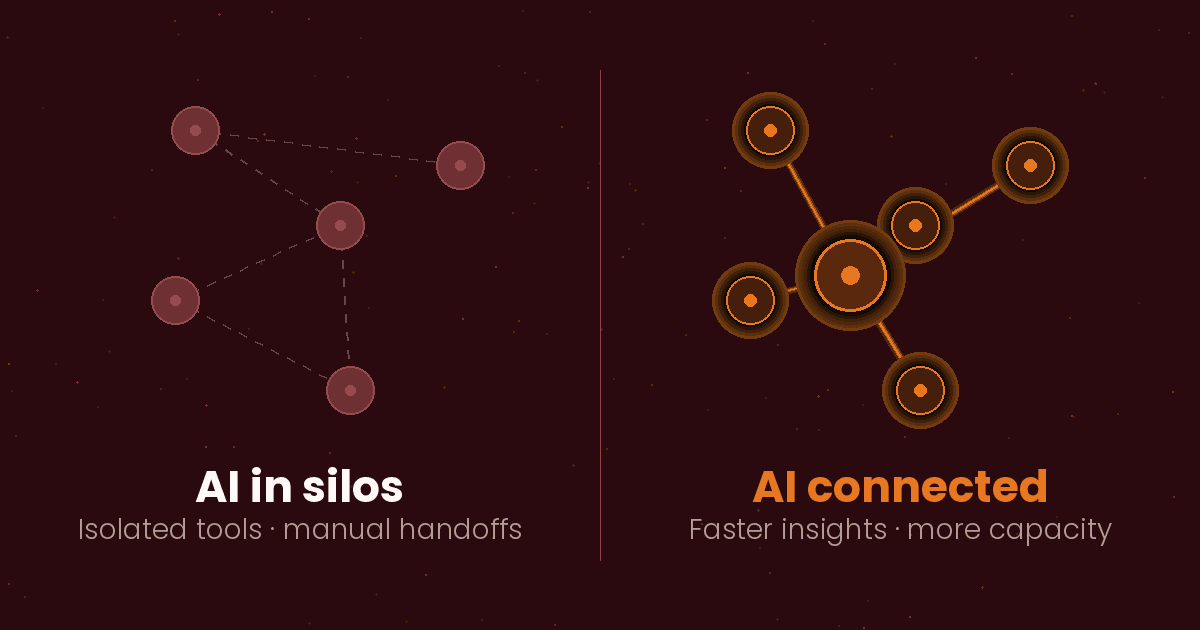
Using AI features inside individual tools is like having a brilliant assistant in every room of your office, but they can't talk to each other. You're still the one walking between rooms, carrying information, and doing the connecting work.
Let me show you what I mean.
The Two Ways Businesses Think They're "Using AI"
The ChatGPT-as-Search Approach
Lots of teams use ChatGPT like an upgraded Google. They ask questions, get answers, copy-paste the results into their work, and move on to the next task.
The limitation? It's still manual. You're still copying. You're still doing the work of transferring information
between tools.
The AI-Features-in-Tools Approach
Others use AI features inside tools they already have - AI writing in email platforms, AI summaries in their CRM, AI design suggestions in Canva.
The limitation? Each tool works in isolation. Your CRM's AI doesn't talk to your email platform's AI. Your research in ChatGPT doesn't automatically inform your proposal tool. There's no compounding value because nothing connects.
Here's the key insight: Both approaches use AI. But neither unlocks the real power of AI automation, where AI works across your tools, connecting them without manual handoffs.
What "AI Across Your Tools" Actually Means
Let me show you a concrete example: qualifying a new sales lead.
AI in your tools (siloed approach):
- Lead comes into your CRM (AI scores the lead automatically)
- You manually research the company on LinkedIn or ask ChatGPT
- You copy your findings into your email platform
- Your AI email tool suggests subject lines
- You manually personalise and send the email
Total time: 20-30 minutes per lead
AI across your tools (connected approach):
- Lead enters your CRM → automation kicks off automatically
- AI researches company details (LinkedIn, web, funding databases, recent news)
- AI analyses the best approach based on company data
- AI drafts a personalised email with research context
- You review and approve (crucial point, you're still in control)
- Email sent automatically once you approve
Total time: 2-3 minutes (just your review)
This isn't about removing humans from the process. It's about automating the repetitive research and drafting so you can focus on strategy and relationship-building.
Real Example: Lead Intelligence in Action
Recently, we worked with a tech company facing this exact challenge.
Their situation:
- Sales team spending 15-20 minutes per lead on research
- Qualifying 50+ leads monthly
- AI feature in their CRM helped with scoring, but all the research was still manual
- Result: 12-15 hours monthly spent on repetitive lead research that felt necessary but wasn't strategic
What we built:
We connected their CRM, LinkedIn data sources, company research APIs, and email platform using an automation platform. Here's what happens now:
- Lead enters CRM → automation triggers automatically
- AI researches company size, funding stage, key decision-makers, and recent company news
- AI generates a personalised email based on that research context
- Email routes to the sales rep for human review before sending
- Crucially: The sales rep approves the messaging and maintains full relationship control
Results:
- Research time: 15 minutes → 2 minutes per lead (93% reduction)
- Sales team capacity: Handle 3× more leads without hiring
- Personalisation quality: Improved (AI had access to more data points than manual research could cover)
- Time freed up: 10-12 hours monthly redirected to high-value prospect conversations
The difference?
They weren't using more AI. They were using AI across their tools instead of inside isolated features.
The AI didn't just "help" in one place; it orchestrated the entire workflow, pulling data from multiple sources and creating a seamless process that only required human judgment at the approval stage.
Why This Matters Now
Here's what I'm seeing in the market right now:
Most businesses are in one of two camps:
- The 'We'll Wait' Group: Watching AI from the sidelines, waiting for it to "mature"
- The 'Early Learners' Group: Experimenting with connected automation now, learning what's possible
The gap between these groups is widening fast.
The businesses learning to connect AI across their tools today are:
- Building internal knowledge of what automation can actually do
- Training teams to think in terms of connected workflows
- Positioning themselves to ride the next wave of AI capability
Meanwhile, the 'wait and see' group is falling behind, not because the technology isn't available, but because they think they're already using AI with a ChatGPT subscription or a single AI feature in their CRM.
The opportunity cost?
Your competitors are learning to leverage automation platforms now. They're building muscle memory around what's possible. By the time the 'wait and see' group decides to start, the learning curve will be steeper and the competitive gap wider.
You're not behind because you don't have AI. You're behind because you're using AI in silos instead of across your workflows.
How to Know if You're Ready
You might benefit from connected AI automation if:
- You copy-paste data between tools regularly
- Your team spends hours on repetitive research or admin tasks
- You have AI features in multiple tools that don't talk to each other
- You're hiring (or considering hiring) to handle a workload that feels repetitive
- You want to scale output without scaling headcount proportionally
Here's the reassurance: You don't need to automate everything. Start with one repetitive workflow that takes time away from strategic work. Build from there.
What This Looks Like in Practice
If you're reading this thinking, 'We probably have workflows we could connect' — you're right.
The businesses I work with typically start with:
- Lead qualification and research (like the example above)
- Content distribution across multiple platforms
- Client onboarding documentation and follow-ups
- Proposal generation with personalised research
The pattern? Repetitive tasks that require pulling data from multiple places, doing similar research each time, and copying information between systems.
The process? We map your current workflow, identify where AI can connect tools you already use, build the automation, and train your team to maintain control through human review.
Most businesses see measurable time savings within 6-10 weeks, often freeing up 10+ hours weekly that can be redirected to growth activities.
Ready to Explore What's Possible?
Let's have a conversation - no pressure, just clarity.
In a 30-minute discovery call, we'll:
- Map one repetitive workflow in your business
- Identify where AI could connect your existing tools
- Discuss whether automation makes sense now or later
If it's a fit, we'll talk next steps. If not, you'll walk away with a clearer picture of where automation could add value in future.
Let's chat 🚀
Related Articles

Case Study: AI Transforms RFQ Processing for Commercial Flooring Business
Designs4You transformed its RFQ processing with AI automation that takes inbound emails, intelligently extracts data and creates structured projects in Airtable
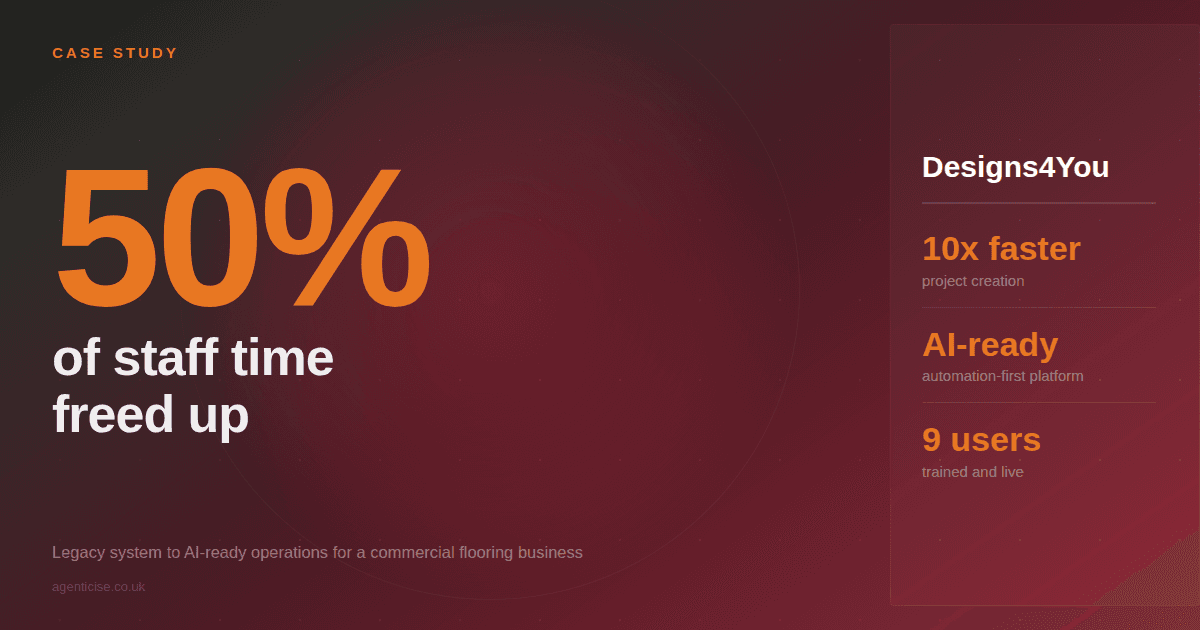
Case Study: Modernising a Commercial Flooring Project Management System
A family-run commercial flooring business was held back by a legacy project management system with no integrations or automation capabilities.
5 Problems AI Automation Actually Solves
AI automation works when it solves real problems, not shiny ideas. The best businesses target painful bottlenecks that waste time and cause errors.