Building Your AI Automation Strategy
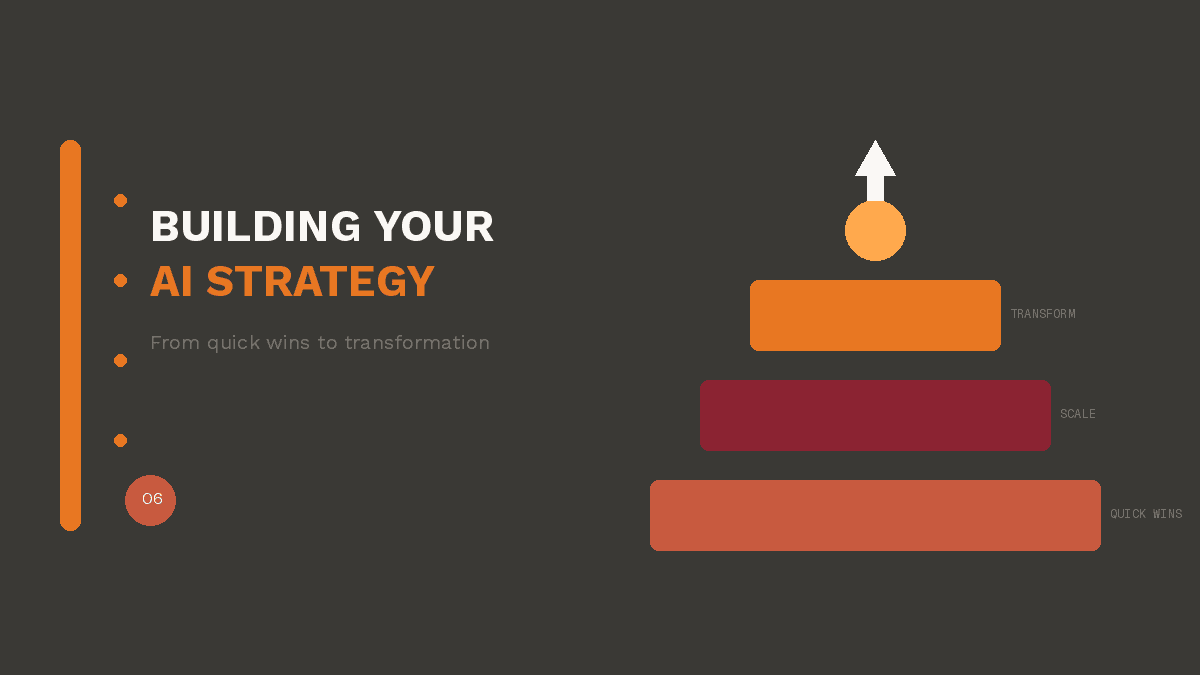
Quick wins are great. There's nothing wrong with automating a single workflow, saving a few hours a week, and calling it a success.
But the businesses that get the most value from AI automation don't stop there. They build strategically, connecting individual automations into systems that compound over time. What starts as a time-saving tool becomes a genuine competitive advantage.
This final post in our series explores how to think beyond your first automation and build toward something more transformative.
The Three Stages of Automation Maturity
Most businesses progress through three distinct stages as their automation capabilities develop:
Stage 1: Tactical
This is where everyone starts. Individual workflows solve specific problems. A lead research automation here, an automated report there. Each one delivers value on its own terms.
At this stage, you're proving the concept. You're learning how automation works in your business, building confidence, and demonstrating ROI. The wins are real but isolated.
Stage 2: Operational
This is where things get interesting. Instead of standalone automations, you start connecting them into systems. Your lead research automation feeds into your CRM, which triggers your nurture sequence, which logs activities for your weekly report.
Information flows between processes. Teams start working differently because automation handles the connective tissue between their tasks. The impact becomes team-wide rather than individual.
Stage 3: Strategic
At this stage, automation becomes part of how you compete. Your response times are faster than competitors because research happens instantly. Your customer experience is more consistent because nothing falls through the cracks. Your team focuses on high-value work because the repetitive stuff handles itself.
Automation isn't just saving time anymore. It's enabling capabilities you couldn't have without it.
Why Most Businesses Stay Stuck at Stage 1
The jump from Stage 1 to Stage 2 is where most businesses stall. They get their quick win, enjoy the time savings, and then... nothing. Months pass without further progress.
Three reasons this happens:
No roadmap. Without a plan for what comes next, the first automation becomes a one-off project rather than the start of something bigger. Nobody's thinking about how it connects to future work.
Siloed thinking. Different teams automate their own processes without considering how they might connect. Sales has its automation, marketing has theirs, operations has theirs. They don't talk to each other.
Fear of going too far. Some businesses worry that more automation means more risk, more complexity, or more dependence on technology. So they hold back, even when the opportunity is clear.
The solution isn't to rush ahead recklessly. It's to approach automation with a strategy that builds deliberately toward larger goals.
Building Your Automation Roadmap
A good automation roadmap starts with your business goals, not the technology.
Step 1: Define your outcomes
What does success look like for your business over the next 12 to 24 months? More leads? Faster sales cycles? Better customer retention? Increased capacity without increasing headcount?
Your automation strategy should serve these goals directly. Every automation you build should connect to an outcome that matters.
Step 2: Map your processes
Before you can automate strategically, you need to understand how work actually flows through your business. Where does information come from? Where does it need to go? What are the handoffs between people and teams?
This mapping often reveals opportunities you hadn't considered. Bottlenecks become visible. Redundant steps stand out. The connections between processes become clearer.
Step 3: Prioritise by impact and feasibility
Not everything should be automated, and not everything should be automated now. Score your opportunities on two dimensions:
- Impact: How much value would this automation deliver? Time saved, errors reduced, capacity unlocked, revenue enabled.
- Feasibility: How straightforward is this to build? Data availability, tool connectivity, process clarity, organisational readiness.
High-impact, high-feasibility items go first. High-impact, low-feasibility items need groundwork before they're ready. Low-impact items, regardless of feasibility, can wait or be skipped entirely.
The Phased Approach: How Strategic Automation Actually Gets Built
At Agenticise, we structure every significant engagement in phases. This isn't just project management preference. It's a deliberate strategy that reduces risk and compounds value.
Phase 1: Foundation (typically 6 to 10 weeks)
Build your first automation or set of core automations. Prove ROI quickly. Establish the technical foundations, system connections, and working patterns that future work will build on. This phase takes longer because it includes the essential groundwork: setting up credentials, configuring integrations, and ensuring everything connects reliably.
This phase answers the question: "Does this work for us?"
Phase 2: Expansion (typically 6 to 8 weeks)
Add connected workflows. Scale the impact from individual to team-wide. Start linking processes together into systems. With the foundations already in place, this phase moves faster while adding more capability.
This phase answers the question: "How do we get more value from what we've built?"
Phase 3: Optimisation (typically 4 to 8 weeks)
Refine and enhance. Add advanced features, improve monitoring, extend capabilities. Turn good automations into great ones.
This phase answers the question: "How do we maximise what we have?"
These phases don't have to run back-to-back. Many clients complete Phase 1, see the results, then decide when to move to Phase 2 based on their priorities and capacity. Others move straight through all three as part of a planned transformation.
A global technology company we work with followed exactly this progression. Phase 1 established their content multiplication system, proving they could scale output without scaling headcount. Phase 2 expanded to additional content types and distribution channels. Phase 3 added performance tracking and iterative improvement based on what was working.
By the end, they had a comprehensive content operation that would have been impossible to build all at once. But built incrementally, each phase validated the next.
Measuring Success: The ROI Question
How do you know if your automation strategy is working? You measure it.
Time saved per week
The most direct metric. How many hours are you reclaiming from repetitive tasks? Multiply by the hourly cost of the people doing that work to get a pound figure.
Capacity unlocked
What can your team do now that they couldn't before? More leads processed, more content published, more customers served. This often matters more than raw time savings.
Error reduction
How many mistakes were happening before, and how many happen now? Errors have costs: rework, customer complaints, missed opportunities. Reducing them has real value.
Speed improvements
How long did key processes take before, and how long do they take now? Faster lead response, quicker report generation, shorter customer wait times. Speed often translates directly to revenue or satisfaction.
Built In Digital tracked all of these. Their partner onboarding automation delivered over 1,500% ROI, with payback in just 8 weeks.
Read the Built In Digital case study →
Collektiv Club saw similar results with their member communication automation. An 83% reduction in processing time freed their team to focus on high-value relationship building instead of email drafting.
Read the Collektiv Club case study →
These aren't exceptional cases. They're typical of what strategic automation delivers when it's designed around clear business outcomes.
When to Bring in an Expert (vs DIY)
Not every automation requires outside help. Here's how to think about the choice:
DIY makes sense when:
- The automation is simple, involving just one or two tools
- Templates or pre-built solutions exist for your use case
- You have technical capacity in-house and time to learn
- The stakes are relatively low if something goes wrong
- You're automating a personal workflow rather than a team process
An expert makes sense when:
- Multiple tools need to connect in complex ways
- The process is business-critical, and errors would be costly
- You need reliability, monitoring, and ongoing support
- Speed matters, and you don't have time to learn from scratch
- You want strategic guidance, not just technical implementation
- You're building toward Stage 2 or Stage 3 maturity
The right answer depends on your specific situation, resources, and goals. There's no shame in starting with DIY for simple wins and bringing in expertise when the stakes rise.
Your Next Step Isn't Buying Software
If you've read this far, you understand what AI automation is, what problems it solves, how to get started, why human oversight matters, how tools connect, and how to think strategically about building capabilities over time.
The next step isn't researching more tools or reading more articles. It's having a conversation about your specific situation.
What are your biggest time drains? Which processes are automation-ready? What outcomes matter most to your business? Where should you start, and what should you build toward?
These questions don't have generic answers. They need to be worked through in the context of your business, your team, and your goals.
The Cost of Waiting
Here's the truth about AI automation in 2026: the gap between businesses that are building and businesses that are watching is widening every month.
The early movers aren't just saving time. They're developing capabilities, building institutional knowledge, and creating operational advantages that compound over time. They're learning what works in their specific context through real experience, not theory.
The businesses waiting for things to "settle down" or for the "right moment" are falling behind in ways they might not even recognise yet. By the time they start, their competitors will have years of compounding advantage.
You don't need to automate everything. You don't need to transform overnight. But you do need to start.
Ready to Build Your Automation Roadmap?
If you've recognised opportunities throughout this series, let's turn that recognition into action.
In a discovery call, we'll map your highest-impact automation opportunities, discuss what a phased approach might look like for your business, and give you a clear recommendation on where to start, whether or not you work with us.
The businesses that thrive in the coming years will be the ones that started building their foundations today. Don't let another month pass while your competitors pull ahead.
Related Articles
How AI Automation Connects Your Tools (Without the Headache)
You don’t need to know code to use AI automation. This post explains, in plain English, how AI connects your business tools and what’s possible.

Human-in-the-Loop: Why the Best AI Keeps You in Control
AI can get things wrong. Human-in-the-Loop automation keeps people in control, preventing small mistakes from becoming big problems.
What Is AI Automation? (And What It Means for Your Business)
This post explains what AI automation is, how it differs from traditional automation, and how growing businesses use it in practice.